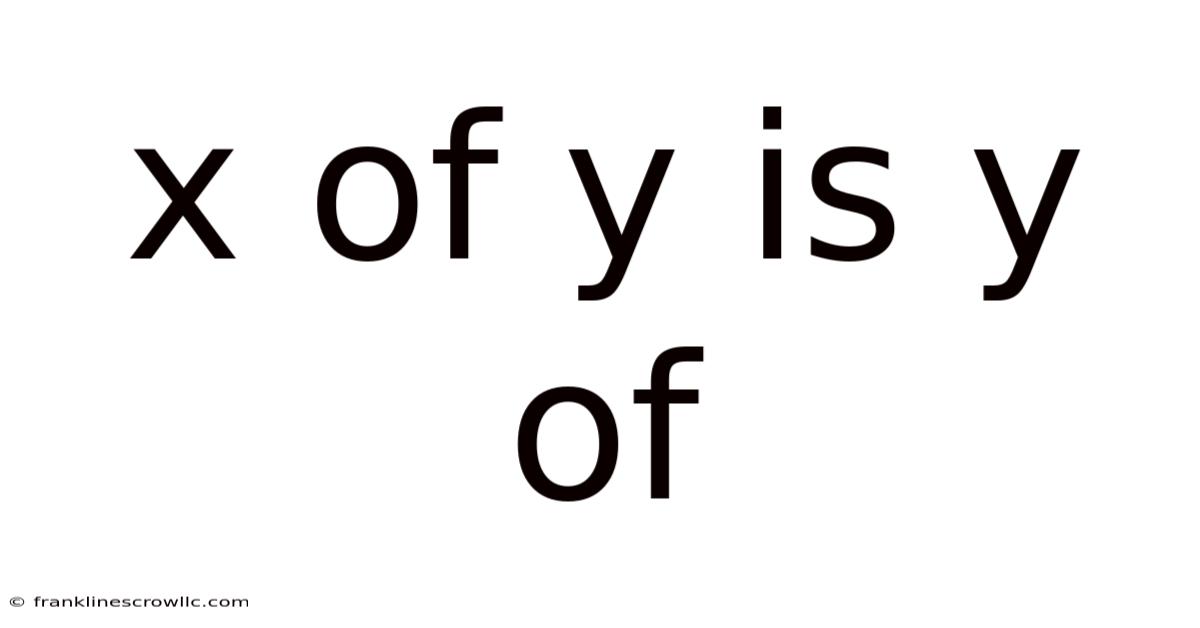
The phrase “x of y is y of” may look cryptic at first glance, but it opens a fascinating window into how we interpret relationships, proportions, and reciprocity across language, mathematics, and culture. Understanding what “x of y is y of” means can enrich your grasp of symbolic communication and help you see hidden patterns in everyday expressions.
Introduction
Expressions that combine variables with relational words often serve as shorthand for deeper concepts. “x of y is y of” sits at the intersection of algebra, linguistics, and philosophy, inviting readers to explore how a simple structure can encapsulate ideas of equivalence, symmetry, and perspective. This article unpacks the multiple layers of this phrase, offering clear definitions, real‑world examples, and practical insights that will make the concept stick The details matter here. Practical, not theoretical..
What the Phrase Literally Means
At its most basic level, “x of y” denotes a portion, a component, or a relationship where x is being described in terms of y. When we add “is y of,” we are asserting that the first relationship mirrors the second, often implying a reciprocal or inverse connection. In plain language, the phrase can be read as:
- A part of B is the same as B’s part of A
This symmetry suggests that the two sides of the statement are interchangeable, a notion that resonates strongly in mathematics (inverse operations) and in everyday reasoning (mutual dependence).
Mathematical Interpretation
Proportions and Ratios
In mathematics, “x of y” often appears in ratio notation. As an example, “½ of 10 is 10 of ½” translates to the same numerical value:
- ½ × 10 = 5
- 10 × ½ = 5
Both expressions yield the same result, illustrating the commutative property of multiplication. The phrase “x of y is y of” therefore highlights that the order of operands does not affect the outcome when the operation is commutative The details matter here..
Inverse Relationships
When the operation is not commutative, the phrase can still convey a meaningful relationship. Consider division:
- 10 ÷ 2 = 5
- 2 ÷ 10 = 0.2
Here, “x of y” (10 of 2) is not the same as “y of x” (2 of 10). The phrase “x of y is y of” becomes a prompt to examine whether the underlying operation preserves symmetry. In calculus, the derivative of a function and the function itself are related but not identical, echoing the same idea of a partial equivalence.
Linguistic and Rhetorical Use
Figurative Language
Writers often employ “x of y is y of” to create parallelism and point out balance. Consider this: shakespeare’s “*When shall we three meet again? Which means in thunder, lightning, or in rain? *” uses a similar structure to link two conditions, reinforcing the idea that each element mirrors the other That's the part that actually makes a difference..
Legal and Philosophical Statements
Legal documents sometimes embed this pattern to establish reciprocal duties. A clause might read, “The obligations of the contractor are the responsibilities of the client.” Here, “x of y is y of” signals a two‑way obligation, ensuring fairness and mutual accountability That alone is useful..
Practical Applications
Problem‑Solving Frameworks
When tackling complex problems, breaking them into “x of y” components can simplify analysis. The steps are:
- Identify the primary relationship – Determine what x represents and how it relates to y.
- Formulate the reciprocal – Express the inverse relationship as “y of x.”
- Test for symmetry – Check whether the two statements produce the same result or meaningful counterpart.
Applying this method to puzzles, coding challenges, or even everyday decisions often reveals hidden constraints or opportunities.
Communication and Persuasion
In presentations, using the structure “The benefits of our product are the priorities of our customers” creates a powerful echo that resonates with audiences. The phrase “x of y is y of” thus becomes a rhetorical device that reinforces mutual value Simple as that..
Common Misinterpretations
- Assuming commutativity – Not all operations are commutative; assuming they are can lead to calculation errors.
- Overlooking context – The phrase can be metaphorical; literal mathematical equivalence may not hold.
- Confusing proportion with equality – “x of y” may indicate a ratio, not an exact equality, so interpreting “is y of” as identical can be misleading.
FAQ
Why is the phrase useful in teaching?
It visualizes the concept of reciprocity, helping students grasp abstract ideas like inverse functions, proportional reasoning, and symmetrical arguments through a simple, memorable structure But it adds up..
Can “x of y is y of” be extended to more than two elements?
Yes. You can create chains such as “x of y is y of z, which is z of x,” exploring cyclic relationships in mathematics, chemistry (reaction cycles), or narrative structures.
Is this pattern found in programming?
Absolutely. Many algorithms rely on swapping variables (e.g., temp = a; a = b; b = temp), embodying the “x of y is y of” exchange principle.
Conclusion
The seemingly enigmatic phrase “x of y is y of” serves as a compact emblem of symmetry, reciprocity, and relational thinking. That said, by dissecting its literal meaning, mathematical resonance, linguistic elegance, and practical utility, we uncover a versatile tool for problem‑solving, communication, and conceptual exploration. Whether you’re balancing a budget, drafting a persuasive argument, or simply enjoying a riddle, recognizing the underlying pattern can sharpen your analytical skills and enrich your perception of the world’s interconnected structures Nothing fancy..
Practical Exercises for Deeper Mastery
To internalize the “x of y is y of” mindset, try these hands-on activities:
- Reciprocal Journaling – Each evening, write one decision you made using the format “My x of y was y of x.” For example: “My listening to feedback was feedback to my listening.” Reflect on how the reversal shifts perspective.
- Code Refactoring Drill – Take a small function that transforms data (e.g.,
serialize↔deserialize,encrypt↔decrypt). Rewrite it so the inverse operation is explicit, then verify that composing both returns the original input. - Debate Flip – In a low-stakes disagreement, restate the other person’s point as “Your concern of X is X of concern.” This forces empathy and often surfaces shared ground.
- Visual Mapping – Draw a bipartite graph where nodes are concepts (budget, time, quality) and edges are “x of y” relationships. Highlight cycles; they reveal systemic apply points.
Regular practice turns the pattern from a curiosity into a reflexive analytical lens.
Historical Echoes
The reciprocity principle predates modern notation. In real terms, in Euclid’s Elements, Proposition 5 of Book VII states: “If a number be a part of a number, and another be the same part of another, alternately also, whatever part or parts the first is of the third, the same part or parts will the second be of the fourth. ” Medieval scholars expressed this as “quantitas qualitatis est qualitas quantitatis”—quantity of quality is quality of quantity—anticipating today’s “x of y is y of” by centuries. Even poetic forms like chiasmus (“Ask not what your country can do for you—ask what you can do for your country”) exploit the same structural inversion to persuade and memorize.
Final Note
The elegance of “x of y is y of” lies in its scalability: it works on a napkin sketch, a whiteboard algorithm, or a keynote slide. By making reciprocity visible, it invites us to question assumptions, uncover hidden symmetries, and design solutions that honor the bidirectional nature of reality. Keep the phrase in your mental toolkit—whenever you encounter a one-way claim, flip it, test it, and watch the landscape of possibilities expand.
