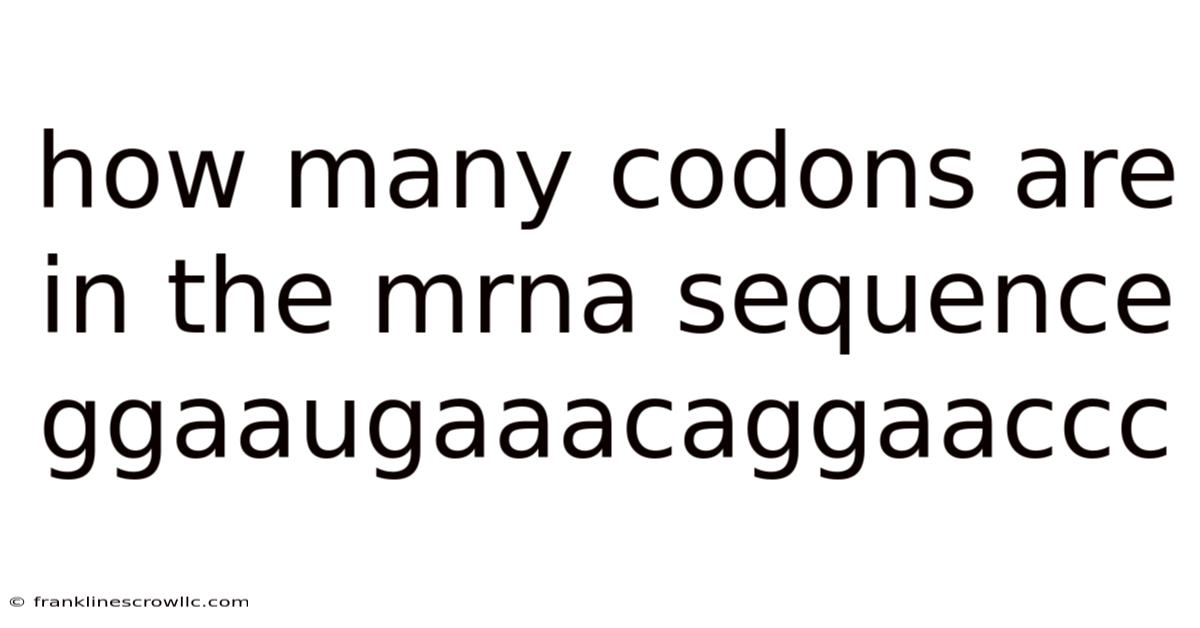
How Many Codons Are in the mRNA Sequence GGAUGAAACAGGAACCC?
The mRNA sequence GGAUGAAACAGGAACCC contains exactly 6 codons. These codons are read in groups of three nucleotides during translation, and they play a crucial role in determining the amino acid sequence of a protein.
Breaking Down the mRNA Sequence into Codons
To determine how many codons are in the given mRNA sequence, we divide it into triplets starting from the 5' end:
- GGA
- UGA
- AAA
- CAG
- GAA
- CCC
Each group of three nucleotides forms a codon, and there are 6 codons in total within this sequence.
Understanding Codons and Their Functions
A codon is a sequence of three nucleotides in messenger RNA (mRNA) that corresponds to a specific amino acid or a start/stop signal during protein synthesis. The genetic code is essentially a set of rules that defines how these codons are translated into proteins.
Types of Codons
There are several types of codons:
- Start codons: Signal the beginning of translation (e.g., AUG).
- Stop codons: Signal the end of translation (e.g., UAA, UAG, UGA).
- Sense codons: Code for amino acids.
- Silent codons: Do not change the amino acid but may affect gene expression or mRNA stability.
Decoding Each Codon in the Sequence
Let’s decode each codon in GGAUGAAACAGGAACCC using the standard genetic code:
- GGA – Glycine (Gly)
- UGA – Stop codon (does not code for an amino acid)
- AAA – Lysine (Lys)
- CAG – Glutamine (Gln)
- GAA – Glutamic acid (Glu)
- CCC – Proline (Pro)
Interestingly, the second codon (UGA) is a stop codon, which typically signals the termination of translation. Basically, if this mRNA were being translated, the ribosome would likely stop at the second codon, resulting in a very short peptide chain.
The Role of mRNA in Protein Synthesis
Messenger RNA (mRNA) serves as an intermediary between DNA and the protein synthesis machinery. During transcription, a segment of DNA is copied into mRNA. This mRNA then travels from the nucleus to the cytoplasm, where it is translated into a protein by ribosomes Small thing, real impact..
Key Steps in Translation
- Initiation: The small ribosomal subunit binds to the mRNA near the start codon (usually AUG).
- Elongation: Transfer RNA (tRNA) molecules bring amino acids to the ribosome, matching their anticodons to the mRNA codons.
- Termination: When a stop codon is reached, release factors bind, and the newly synthesized protein is released.
In our example, since the sequence begins with GGA rather than AUG, it does not contain a traditional start codon. That said, in some cases, translation can begin at non-AUG codons, though this is less common.
Reading Frames and Their Importance
The way an mRNA sequence is divided into codons depends on the reading frame. There are three possible reading frames in any mRNA sequence, depending on where translation begins:
- Frame 1: Starts at the first nucleotide (GGA...)
- Frame 2: Starts at the second nucleotide (GAA...)
- Frame 3: Starts at the third nucleotide (AUG...)
For the sequence GGAUGAAACAGGAACCC, we used Frame 1, which gives us 6 codons. If we used another frame, the number of codons and their meanings would change.
Biological Implications of This Sequence
The presence of a stop codon early in the sequence suggests that this mRNA may not produce a full-length protein under normal conditions. Instead, it might be involved in regulatory processes or represent a truncated version of a larger gene product Less friction, more output..
Additionally, sequences containing multiple stop codons can act as non-coding RNAs or be targeted for degradation by cellular quality control mechanisms.
Practical Applications in Molecular Biology
Understanding how to count and interpret codons is essential in various fields:
- Genetic engineering: Designing synthetic genes requires careful consideration of codon usage to optimize protein expression.
- Gene therapy: Mutations that introduce premature stop codons can lead to diseases such as cystic fibrosis or Duchenne muscular dystrophy.
- Evolutionary studies: Comparing codon usage across species provides insights into evolutionary relationships and selective pressures.
Frequently Asked Questions
Q: How do you determine the number of codons in an mRNA sequence?
A: Divide the total number of nucleotides by three. For a sequence of 18 nucleotides, there are 6 codons Simple, but easy to overlook..
Q: What happens if a stop codon appears early in the sequence?
A: Translation terminates prematurely, often resulting in a non-functional or truncated protein.
Q: Can a sequence without a start codon still be translated?
A: Yes, in some cases, ribosomes can initiate translation at non-AUG codons, especially in viruses or certain eukaryotic genes.
Q: Why is the reading frame important?
A: A shift in the reading frame (frameshift mutation) can completely alter the amino acid sequence and lead to dysfunctional proteins Easy to understand, harder to ignore..
Conclusion
The mRNA sequence GGAUGAAACAGGAACCC contains 6 codons, each playing a distinct role in the process of translation. While most of these codons correspond to amino acids, the presence of a stop codon (UGA) early in the sequence suggests that this mRNA may not code for a full-length protein. Here's the thing — understanding how to read and interpret codons is fundamental to molecular biology, genetics, and biotechnology. Whether you're studying gene expression, designing experiments, or exploring evolutionary biology, mastering the language of codons is an essential skill for any student or researcher in the life sciences.
The Broader Significance in Modern Research
The ability to accurately parse and predict the consequences of codon sequences has become increasingly vital in the era of genomics and synthetic biology. With the advent of technologies like CRISPR-Cas9 gene editing, scientists can precisely alter codons to correct genetic mutations or introduce desired traits. What's more, computational tools powered by artificial intelligence now use codon optimization algorithms to design genes that are not only functional but also highly efficient in specific host organisms, a cornerstone of modern biomanufacturing It's one of those things that adds up. Took long enough..
This is the bit that actually matters in practice.
From an educational perspective, the exercise of counting codons and identifying their functions serves as a fundamental bridge between the abstract genetic code and its tangible manifestations in health and disease. It demystifies the process by which the instructions in our DNA are executed, highlighting the elegance and precision of molecular machinery.
Not the most exciting part, but easily the most useful Most people skip this — try not to..
Boiling it down, the analysis of the sequence GGAUGAAACAGGAACCC reveals more than just a list of codons; it illustrates the core principles of genetic translation, the critical importance of reading frames, and the profound implications of even a single nucleotide change. As we continue to decode the complexities of life, the language of codons remains our most essential guide, informing everything from basic research to the next generation of therapeutic innovations.
Short version: it depends. Long version — keep reading.
Looking Ahead: The Evolving Fluency of Genetic Language
As we transition from merely reading the genetic code to writing and rewriting it on a genomic scale, the humble codon emerges not just as a unit of translation, but as a fundamental building block of biological engineering. Plus, the next frontier lies in expanding the genetic alphabet itself. Researchers are actively developing unnatural base pairs (UBPs) and quadruplet codons to incorporate non-standard amino acids (nsAAs) into proteins. This "codon emancipation" promises to create biologics with enhanced stability, novel catalytic functions, or precise therapeutic targeting—capabilities impossible within the constraints of the standard 64-codon repertoire.
Simultaneously, the study of codon usage bias across the tree of life is revealing a hidden layer of gene regulation. Far from being synonymous, "silent" mutations that swap one codon for another encoding the same amino acid can drastically alter protein folding kinetics, mRNA stability, and expression levels by modulating the speed of ribosomal transit. This insight is revolutionizing vaccine design—where codon deoptimization creates attenuated viruses—and cancer immunotherapy, where optimizing neoantigen codons enhances immune recognition Nothing fancy..
Final Perspective
The journey from the triplet hypothesis of the 1960s to today’s synthetic genomes underscores a profound truth: biology is an information science. The sequence GGAUGAAACAGGAACCC, analyzed in its simplicity, serves as a microcosm of this vast landscape. It reminds us that within every three-nucleotide window lies a decision point—a signal to start, a command to incorporate, or an order to stop.
Mastering this language allows us not only to diagnose the errors that cause disease but to author new biological solutions for a changing world. Whether you are a student counting codons on a page or a bioengineer designing a synthetic chromosome, the principle remains the same: precision in the code begets function in the organism. As our fluency deepens, the boundary between reading life's script and editing it continues to blur, heralding an era where the genetic code is not just understood, but deliberately composed And that's really what it comes down to. Less friction, more output..
